

Vogt-CTE supplies defense technology that works under real-world conditions: in resilient infrastructures, in decentralized deployment scenarios, with a focus on sustainability and energy efficiency.
Our solutions are designed to make tactical operations more efficient, secure, and effective—even under extreme conditions. In doing so, we create solutions that support today’s threat scenarios and deliver real added value both in active field operations and at the interface with civilian applications.

PowerUP – Hydrogen fuel cell generators and powersupplys for tactical use

EuroHeater – Multi-fuel diesel air heaters for tactical and military use

FlexiBatt – Rechargeable batterypacks and systems for tactical use
FirstLook – Location cameras and search cameras for tactical use
MarenFasty – Water reconnaissance drones for tactical use

Rigloo – Protective shelter tents for tactical and military rescue operations

BlowHard –
Mobile ventilation systems for tactical and military use

Make an online-appointment with Vogt-CTE today. Microsoft Teams

Receive a personalized and customized Vogt-CTE offer

Become part of our European network of sales and system partners
The PowerUp – UpMobile is a mobile large generator with 10 kW power, developed for demanding military and tactical environments where energy must be reliably available at all times. Whether as a power source for command and communication equipment, for sensors, lighting, workshop operations, or as the backbone of a mobile infrastructure, UpMobile delivers stable electrical power where there is no grid connection or where the grid fails.
The focus is on robustness, quick deployability, and operational reliability. The system is designed to withstand transport, vibration, dust, and weather and to fit into existing logistics and supply processes. Thanks to clear operating logic and practical interfaces, the generator can be quickly put into operation and flexibly adapted to changing load profiles. This makes energy supply a predictable factor—even under changing conditions.
In short: PowerUp – UpMobile stands for 10 kW of operational, mobile energy that combines resilience with ease of use, thereby increasing the endurance of units, locations, and mobile facilities.
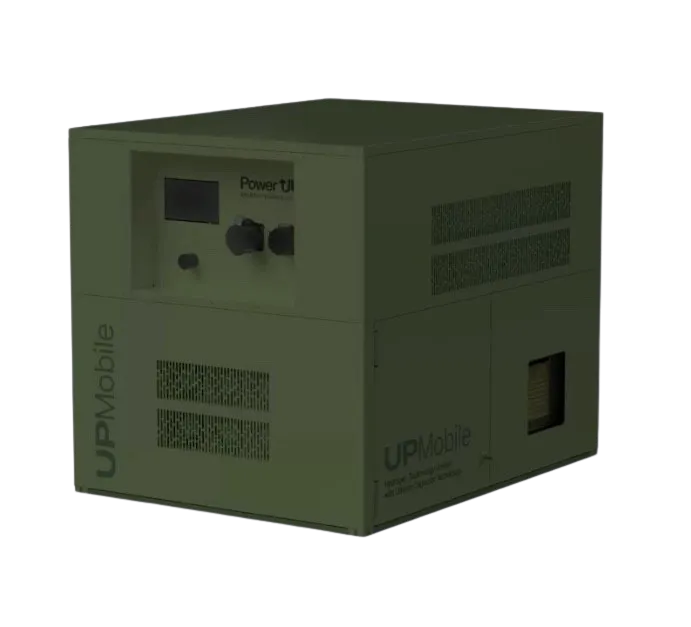
The device is designed to be trailer-friendly and can therefore be easily transported on trailers. Thanks to its transport-optimized design, it can be quickly loaded, securely fastened, and easily moved to different locations—a clear advantage for mobile applications and quick location changes.
| Technical Data | Value |
|---|
| System Voltage | 42–75 V DC |
| Output Voltage | 42–75 V DC; 230 V AC (single-phase); 400 V AC (three-phase) |
| Output Current | 0–300 A |
| Rated Power | 10 kW (BOL) – 9 kW (EOL) |
| Power without Battery | 15 kW (without battery) |
| Fuel Cell Peak Power | 16.4 kW |
| Battery Expansion (Capacity) | 6.8 kWh (1 module) |
| Battery Expansion (Peak Power) | 34 kW (12 min – 5C) |
| Cooling System | Deionized water (0.1 µS/cm) |
| Fuel | Compressed hydrogen (>99.97%) |
| Consumption | 60–73 g/kWh |
| Dimensions (L × W × H) | 1900 × 1500 × 1500 mm |
| Weight | 220 kg |
| Start Temperature | > −10 °C |
| Operating Temperature | 5 °C to 60 °C |
| Operating Lifetime (specified) | 20,000 h |
| Protection Rating | IP54 |
| Noise Level | 65 dB |
| Trailer Compatibility | Trailer-based mobile solution; suitable for transport on a trailer |
| Additional Features (excerpt) | Remote monitoring / IoT logs, Start/Stop signal, fully automatic setup |
Hier sind typische militärische/taktische Anwendungen und Geräteklassen, bei denen ein Aggregat in der 10-kW-Klasse sehr oft passt. Das sind bewusst unterstützende (nicht waffenbezogene) Strombedarfe, wie sie bei Führungs-, Logistik- und Schutzaufgaben auftreten.
Typische taktische Anwendungen für 10 kW
Gefechtsstand / Führungsstelle (klein bis mittel)
Sensorik- und Überwachungs-Posten
Medizinischer Punkt (Role-1/Erstversorgung)
Mobile Werkstatt / Instandsetzung
Logistik- und Versorgungs-Knoten
Unterkunft / Schutzinfrastruktur
Lade- und Energiepunkt für Akkus
Geräte, die typischerweise in der 10-kW-Last stecken (Beispiele)
Small command post:
IT + radio + network (2–4 kW) + lighting (0.2–0.6 kW) + air conditioning/heating (3–6 kW) → typically 6–10 kW
Sensor station in container:
Sensors/IT (2–5 kW) + air conditioning/heating (3–6 kW) → typically 5–11 kW
Mobile workshop:
Base load (1–3 kW) + tool peaks (compressor/welding) → briefly 8–12+ kW, often lower on average
Important practical note
At 10 kW, it is rarely “one device” that is decisive, but rather the sum plus start-up currents (air conditioning, compressors, pumps). A good guideline is to consider continuous load and peak load separately and to plan for a 10–20% reserve.

WE SUPPLY DEFENSE TECHNOLOGY
At Vogt-CTE, we offer our European partners in the security and defense sector access to unique technological innovations. Our solutions are designed to make tactical operations more efficient, safer, and more effective—even under extreme conditions. The systems we represent are highly specialized, field-tested to military standards, and provide a decisive tactical advantage where it counts. We don’t just supply equipment, we deliver operational progress. Together with our partners, we ensure that these innovations end up exactly where they are needed: in the hands of those who are on the front line defending our security and who must be able to rely unconditionally on their technology.