

Vogt-CTE supplies defense technology that works under real-world conditions: in resilient infrastructures, in decentralized deployment scenarios, with a focus on sustainability and energy efficiency.
Our solutions are designed to make tactical operations more efficient, secure, and effective—even under extreme conditions. In doing so, we create solutions that support today’s threat scenarios and deliver real added value both in active field operations and at the interface with civilian applications.

PowerUP – Hydrogen fuel cell generators and powersupplys for tactical use

EuroHeater – Multi-fuel diesel air heaters for tactical and military use

FlexiBatt – Rechargeable batterypacks and systems for tactical use

FirstLook – Location cameras and search cameras for tactical use

MarenFasty – Water reconnaissance drones for tactical use

Rigloo – Protective shelter tents for tactical and military rescue operations

BlowHard –
Mobile ventilation systems for tactical and military use

Make an online-appointment with Vogt-CTE today. Microsoft Teams

Receive a personalized and customized Vogt-CTE offer

Become part of our European network of sales and system partners
An electrolyzer is a technical system for producing hydrogen from water. It uses electrical energy to split water (H₂O) into its chemical components hydrogen (H₂) and oxygen (O₂). This process is called electrolysis.
Basic principle
There is no combustion, but rather a controlled electrochemical process.
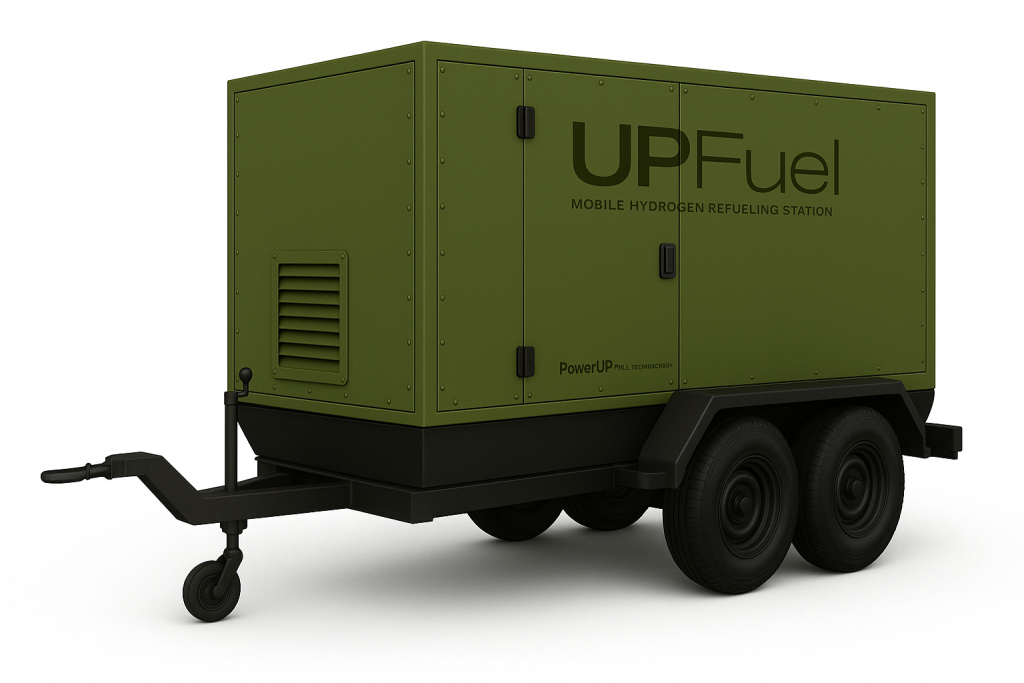
An electrolyzer is a technical system that uses electrical energy to break water down into its basic components, hydrogen and oxygen. This process, known as electrolysis, is based on an electrochemical process that does not involve combustion. Instead, electrical energy is used directly to break the chemical bond of the water molecule. The result is pure hydrogen, which can be stored as an energy carrier or used immediately, and oxygen, which is discharged in a controlled manner.
In practical operation, water is fed into the electrolyzer, which is treated or filtered depending on the system. As soon as electrical energy is applied, the electrolysis process begins. The hydrogen produced is collected, compressed, or temporarily stored and is then available as fuel. This hydrogen can be used directly in fuel cells, which in turn convert it into electrical energy. This creates a closed energy cycle in which electricity is converted into chemical energy, stored, and later converted back into electricity.
The main purpose of an electrolyzer is to convert electrical energy into a form that can be stored long-term, transported, and used in a variety of ways. Electricity can only be stored to a limited extent, especially in mobile or remote environments. Hydrogen, on the other hand, can be stored for long periods of time and used as needed. The electrolyzer thus decouples energy production from energy use and creates new flexibility in the use of energy.
This technology is particularly relevant in the context of decentralized hydrogen production. Decentralized means that hydrogen is not produced in large, central industrial plants and then transported at great expense, but is produced directly where it is needed. Electricity and water are sufficient to establish a local fuel source. This significantly reduces dependence on supply routes, refueling infrastructure, and logistical planning.
The advantages of this decentralized production are manifold. One of the most important aspects is independence from traditional supply chains. In remote regions, crisis areas, or where infrastructure is deliberately avoided, energy can still be provided without the need for regular fuel deliveries. This increases security of supply while reducing the risk of interruptions or failures.
In addition, the combination of electrolyzer and fuel cell operates very quietly and produces no exhaust gases. Compared to conventional generators, there is no engine noise or visible emissions. Heat radiation is also significantly lower. This makes the technology particularly suitable for environments where a low acoustic, visual, and thermal signature is crucial.
Another key advantage is scalability. Electrolyzers can be implemented in various sizes, from compact, mobile systems to containerized or trailer-based plants. Depending on requirements, several units can be combined to achieve higher production volumes. At the same time, hydrogen production can be precisely adapted to actual energy demand.
In addition, decentralized hydrogen production enables the efficient use of existing energy sources. Electrical energy that is generated locally or is temporarily surplus can be converted into hydrogen and stored instead of remaining unused. The hydrogen is then available exactly when energy is needed, regardless of whether electricity is currently being generated or not.
In professional, safety-related, and tactical applications, energy is increasingly seen as a strategic factor. The ability to generate, store, and flexibly use energy determines freedom of action, endurance, and operational reliability. Decentralized electrolysers provide precisely this capability. They transform any suitable location into a local source of energy and fuel and form the basis for self-sufficient energy systems.
In summary, an electrolyzer is much more than a technical component for hydrogen production. It is a key component of modern energy systems that makes electricity storable, reduces supply dependencies, and enables new forms of energy autonomy. Decentralized hydrogen production thus opens the way to a resilient, flexible, and sustainable energy supply—wherever traditional infrastructure is lacking, unavailable, or deliberately avoided.

WE SUPPLY DEFENSE TECHNOLOGY
At Vogt-CTE, we offer our European partners in the security and defense sector access to unique technological innovations. Our solutions are designed to make tactical operations more efficient, safer, and more effective—even under extreme conditions. The systems we represent are highly specialized, field-tested to military standards, and provide a decisive tactical advantage where it counts. We don’t just supply equipment, we deliver operational progress. Together with our partners, we ensure that these innovations end up exactly where they are needed: in the hands of those who are on the front line defending our security and who must be able to rely unconditionally on their technology.