

Vogt-CTE supplies defense technology that works under real-world conditions: in resilient infrastructures, in decentralized deployment scenarios, with a focus on sustainability and energy efficiency.
Our solutions are designed to make tactical operations more efficient, secure, and effective—even under extreme conditions. In doing so, we create solutions that support today’s threat scenarios and deliver real added value both in active field operations and at the interface with civilian applications.

PowerUP – Hydrogen fuel cell generators and powersupplys for tactical use

EuroHeater – Multi-fuel diesel air heaters for tactical and military use

FlexiBatt – Rechargeable batterypacks and systems for tactical use
FirstLook – Location cameras and search cameras for tactical use

MarenFasty – Water reconnaissance drones for tactical use

Rigloo – Protective shelter tents for tactical and military rescue operations

BlowHard –
Mobile ventilation systems for tactical and military use

Make an online-appointment with Vogt-CTE today. Microsoft Teams

Receive a personalized and customized Vogt-CTE offer

Become part of our European network of sales and system partners
Trailer-mounted electrolyzers are mobile systems for the local production of hydrogen using electricity and water. These systems are compact, fully integrated into transportable trailers, and can be used in locations where there were previously few practical options for energy or fuel supply.
Essentially, they convert electrical energy into hydrogen (H₂) by splitting water into its components using electrolysis. The hydrogen produced then serves as a “green fuel” for fuel cells, hydrogen-adapted combustion engines, or other chemical energy storage devices. In conjunction with fuel cell generators such as those from PowerUP, this creates a decentralized “hydrogen filling station” that provides energy where no grid is available.
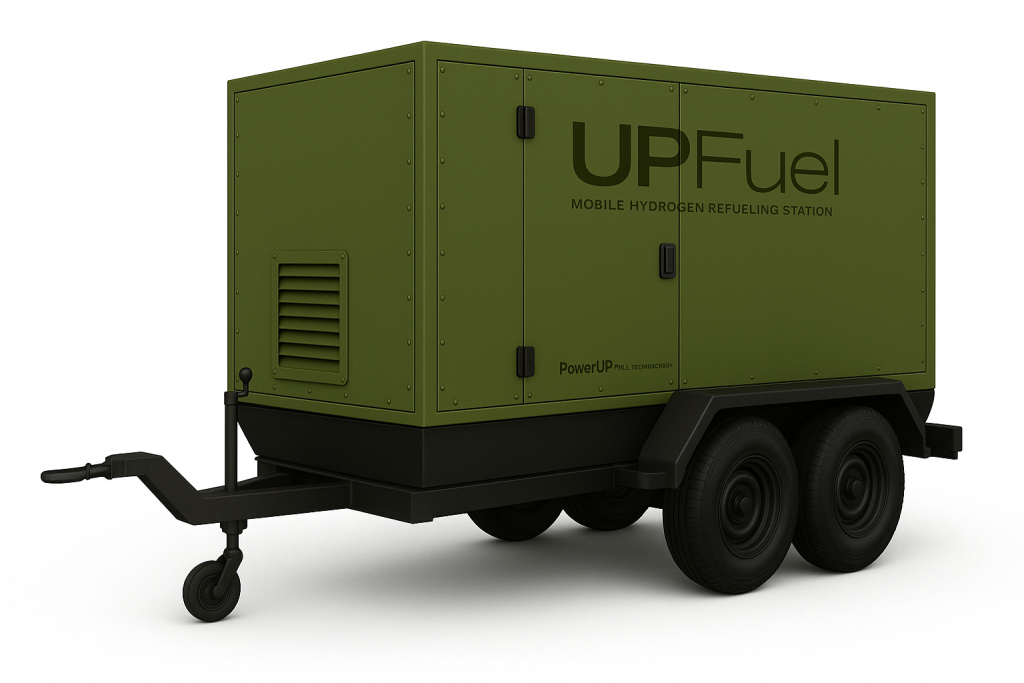
Electrolysis requires electricity. In off-grid electrolysis, energy is provided sustainably directly on site—primarily through photovoltaics and wind power. Photovoltaics reliably supply electricity during the day, but produce nothing at night and significantly less in winter. Wind power is the ideal complement because it can often supply energy at night and during the cold season. To ensure that the electrolyzer runs stably and efficiently despite fluctuating generation, both sources are usually combined and regulated by an energy management system; a battery storage system buffers short-term fluctuations and prevents frequent start-stop cycles. This allows the electrolyzer to be operated for as many hours as possible with renewable energy, without a grid connection.
Self-sufficient hydrogen production
An electrolyzer only needs electricity and water. Hydrogen is produced using renewable energy sources (solar, wind, fuel cells) or existing electrical systems—directly on site, without external hydrogen delivery.
Immediately usable energy for fuel cells
The hydrogen produced on site can be fed directly into fuel cell generators. These convert the H₂ fuel into electricity quietly and without emissions – ideal for tactical communications, sensor technology, command and control systems, or medical infrastructure.
Decentralized supply base
A trailer-mounted electrolyzer transforms any suitable location into a decentralized energy production station. It can be:
This creates local fuel and energy independence
Why trailer-based electrolysers are important in a military context
Self-sufficient energy and fuel supply
In classic scenarios, fuel and energy must be delivered via long, vulnerable logistics chains. These supply routes are often the target of attacks, interruptions, or blockades. With a trailer-based electrolyzer, this dependency is eliminated: fuel is produced on site, not delivered.
Decentralized “filling stations” wherever there is no grid
In remote areas of operation or when moving at speed, a supply convoy often has no chance of keeping up. A trailer-based electrolyzer creates a local refueling/energy infrastructure that:
Reduced logistics burden
Traditional fuel logistics tie up personnel, transport capacity, and risk. Generating hydrogen on site reduces:
Low signature, high efficiency
Unlike diesel generators, hydrogen operation produces:
This is of particular tactical importance in covert operations, nighttime situations, or urban environments.
Outpost supply in remote regions
An outpost is isolated for weeks or months. With a trailer-mounted electrolyzer, it generates its own hydrogen for fuel cell generators for power, communication, sensors, LED lighting, and medical devices.
Advantage: Independence from supply convoys.
Quick-build operational bases
In crisis situations, energy must be available within a short time. The electrolyzer is positioned at the base and supplies all fuel cells. Once the base has been abandoned, it can be quickly relocated.
Advantage: Mobility without dependence on infrastructure.
Night and special operations
Tactical teams need energy without revealing their location. Fuel cells with hydrogen from the electrolyzer operate almost silently and without visible exhaust gases. Advantage: Increased operational safety.
Field camp medicine and medical services
During longer field camp phases, medical devices must be supplied with a stable and clean power supply. Hydrogen generated on site provides emission-free energy without a grid connection. Advantage: Medical care independent of traditional infrastructure.
Energy supply for mobile communication and command centers
Mobile command posts require constant energy for radio, servers, and sensor fusion. Trailer-based electrolysers provide a decentralized “fuel station.” Advantage: Command capability during longer continuous operations.
Why this technology is a game changer
Fuel logistics reimagined. On-site hydrogen production drastically reduces the need for logistical effort. Fuel does not come to the emergency services—the emergency services produce their own fuel.
Modularity and scalability
Trailers can be used individually or in groups, depending on the power requirements. A single electrolyzer can power several fuel cells. Larger units can be connected to each other.
Future-proof energy platform
As modern military systems become increasingly electrified, the trailer-based electrolyzer offers a future-proof solution – for both conventional and fuel cell-based energy systems.
Trailer-based electrolysers generate energy and fuel where there are no supply routes – independently, mobile and tactically inconspicuous. In combination with fuel cell generators such as PowerUP, they become local hydrogen filling stations – a strategic advantage in modern, decentralised, rapidly deployable scenarios. Energy is not delivered, but generated. On site. For every application.

WE SUPPLY DEFENSE TECHNOLOGY
At Vogt-CTE, we offer our European partners in the security and defense sector access to unique technological innovations. Our solutions are designed to make tactical operations more efficient, safer, and more effective—even under extreme conditions. The systems we represent are highly specialized, field-tested to military standards, and provide a decisive tactical advantage where it counts. We don’t just supply equipment, we deliver operational progress. Together with our partners, we ensure that these innovations end up exactly where they are needed: in the hands of those who are on the front line defending our security and who must be able to rely unconditionally on their technology.