

Vogt-CTE supplies defense technology that works under real-world conditions: in resilient infrastructures, in decentralized deployment scenarios, with a focus on sustainability and energy efficiency.
Our solutions are designed to make tactical operations more efficient, secure, and effective—even under extreme conditions. In doing so, we create solutions that support today’s threat scenarios and deliver real added value both in active field operations and at the interface with civilian applications.

PowerUP – Hydrogen fuel cell generators and powersupplys for tactical use

EuroHeater – Multi-fuel diesel air heaters for tactical and military use

FlexiBatt – Rechargeable batterypacks and systems for tactical use

FirstLook – Location cameras and search cameras for tactical use

MarenFasty – Water reconnaissance drones for tactical use

Rigloo – Protective shelter tents for tactical and military rescue operations

BlowHard –
Mobile ventilation systems for tactical and military use

Make an online-appointment with Vogt-CTE today. Microsoft Teams

Receive a personalized and customized Vogt-CTE offer

Become part of our European network of sales and system partners
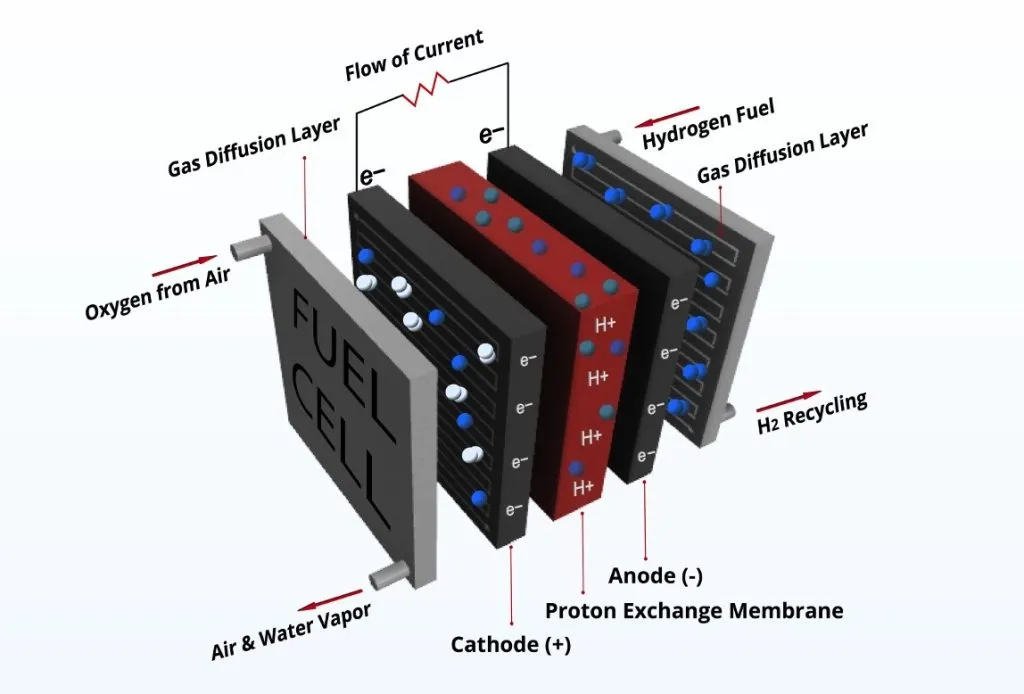
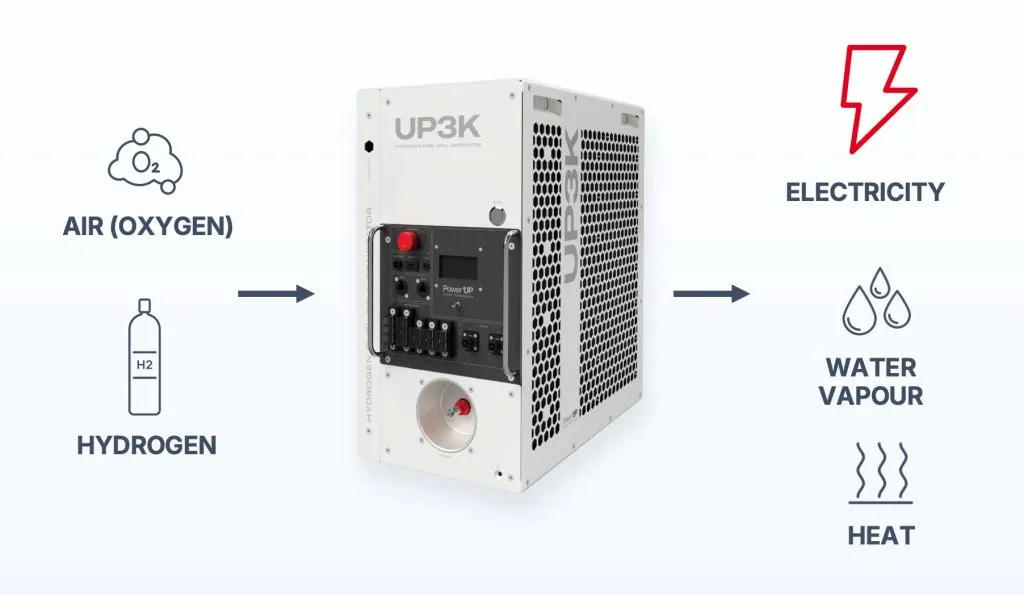
A fuel cell is an electrochemical system that converts hydrogen directly into electrical energy. Unlike conventional combustion engines, no combustion takes place. Instead, the chemical energy stored in the hydrogen is converted into electricity via a controlled electrochemical process. The only by-products are water and heat. This process is quiet, efficient, and emission-free at the point of use.
During operation, hydrogen is fed into the fuel cell. At the anode, the hydrogen is split into protons and electrons. The electrons flow through an external circuit, generating electrical energy that can be used directly or stored. The protons migrate through a special membrane to the cathode. There they react with oxygen from the ambient air and the returning electrons to form water. This partially closed electrochemical cycle runs continuously as long as hydrogen and oxygen (often from the ambient air) are supplied.
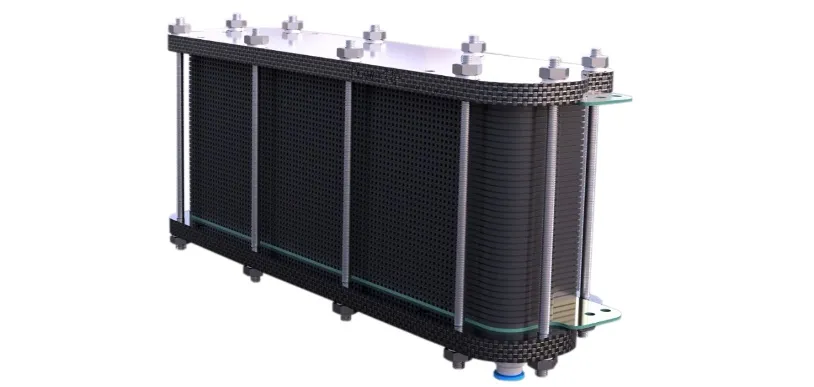
The fuel cell thus fulfills a central task: it converts a chemical energy source directly into electrical energy without the detour via mechanical movement, heat, and rotation. This means that there are hardly any losses due to friction or waste heat, as is common with combustion engines or classic generators. The energy output is stable, consistent, and particularly well suited for sensitive consumers such as communication systems, sensor technology, IT infrastructure, or medical devices.
The main purpose of a fuel cell is to provide reliable, continuous power generation where conventional power grids are lacking, unstable, or deliberately avoided. It is particularly suitable for off-grid operation, i.e., for self-sufficient use without a grid connection. In combination with hydrogen storage, a fuel cell can provide energy over long periods of time without the need for continuous delivery of new fuel.
This concept is particularly effective in conjunction with decentralized hydrogen production. If the hydrogen is not produced and transported centrally, but is generated directly on site by electrolysis, a completely self-sufficient energy system is created. Electricity is used to split water into hydrogen. This hydrogen then serves as fuel for the fuel cell, which generates electricity again when needed. In this way, energy generation, energy storage, and energy consumption can be flexibly decoupled from each other.
The advantages of this decentralized use of hydrogen are considerable. One of the most important aspects is independence from traditional supply routes. Energy no longer has to be delivered in the form of diesel, gasoline, or batteries. Instead, the energy source is produced and used directly at the point of use. This reduces logistical dependencies, lowers risks, and increases security of supply—especially in remote regions or in environments with limited infrastructure.
Another key advantage is the low signature. Fuel cells operate almost silently and produce no visible exhaust gases. Thermal radiation is also significantly lower compared to combustion engines. This makes fuel cells particularly suitable for applications where noise, smoke, or waste heat are undesirable or even critical to safety.
In addition, the combination of fuel cells and decentralized hydrogen production offers high efficiency. Electrical energy can be generated when it is actually needed. At the same time, excess energy can be stored in the form of hydrogen and retrieved later. This principle enables a flexible and demand-oriented energy supply that can be dynamically adapted to changing requirements.
Scalability also plays an important role. Fuel cells can be implemented in different power sizes and combined in a modular fashion. From small, mobile systems to containerized high-performance plants, solutions can be built that are precisely tailored to the respective energy requirements. In conjunction with decentralized electrolysers, this creates local energy centers that can be operated independently of the public grid.
In summary, it can be said that a fuel cell is much more than an alternative power generation device. It is a central component of modern, decentralized energy systems. In combination with locally produced hydrogen, it enables quiet, emission-free, and self-sufficient power supply, reduces dependence on supply routes, and creates new scope for action in environments where classic energy infrastructure is not available or not desired.
| Power Consumption | 9 l (300 bar) approx. 3.5 kWh | 26 l (300 bar) approx. 10 kWh | 50 l (200 bar) approx. 13 kWh | 2 × 50 l (200 bar) approx. 26 kWh | 12 × 50 l (200 bar) approx. 156 kWh |
|---|---|---|---|---|---|
| 400 W | 9 h | 25 h | 32 h | 64 h | 384 h |
| 1 kW | 3 h 30 min | 10 h | 13 h | 26 h | 156 h |
| 3 kW | 1 h 10 min | 3 h 20 min | 4 h 30 min | 9 h | 52 h |
| 15 kW | 13 min | 36 min | 48 min | 1 h 36 min | 9 h 23 min |
| Technology | Emissions | Noise | Maintenance | Operating Costs | Climate Neutral |
|---|---|---|---|---|---|
| PowerUP (H₂) | None | Quiet | Minimal | Medium | Yes (green H₂) |
| Diesel Generator | High | Loud | High | Low | No |
| Methanol Fuel Cell | Medium | Quiet | Medium | Medium | Limited |
| Power Bank / Solar | None | Quiet | Minimal | Low | Yes |
| Technology | Advantages | Disadvantages |
|---|---|---|
| PowerUP (H₂) | Zero emissions, quiet operation, low maintenance, potentially climate neutral | Higher cost per kWh, hydrogen infrastructure required |
| Methanol Fuel Cells | Easy storage (liquid fuel) | CO₂ emissions, fossil origin, toxic |
| Diesel Generator | Cost-effective, reliable | Loud operation, high emissions, regular maintenance required |
| Power Banks | Mobile, easy to use | Suitable only for small loads |

WE SUPPLY DEFENSE TECHNOLOGY
At Vogt-CTE, we offer our European partners in the security and defense sector access to unique technological innovations. Our solutions are designed to make tactical operations more efficient, safer, and more effective—even under extreme conditions. The systems we represent are highly specialized, field-tested to military standards, and provide a decisive tactical advantage where it counts. We don’t just supply equipment, we deliver operational progress. Together with our partners, we ensure that these innovations end up exactly where they are needed: in the hands of those who are on the front line defending our security and who must be able to rely unconditionally on their technology.