
Vogt-CTE supplies defense technology that works under real-world conditions: in resilient infrastructures, in decentralized deployment scenarios, with a focus on sustainability and energy efficiency.
Our solutions are designed to make tactical operations more efficient, secure, and effective—even under extreme conditions. In doing so, we create solutions that support today’s threat scenarios and deliver real added value both in active field operations and at the interface with civilian applications.

PowerUP – Hydrogen fuel cell generators and powersupplys for tactical use
EuroHeater – Multi-fuel diesel air heaters for tactical and military use

FlexiBatt – Rechargeable batterypacks and systems for tactical use
FirstLook – Location cameras and search cameras for tactical use
MarenFasty – Water reconnaissance drones for tactical use

Rigloo – Protective shelter tents for tactical and military rescue operations

BlowHard –
Mobile ventilation systems for tactical and military use

Make an online-appointment with Vogt-CTE today. Microsoft Teams

Receive a personalized and customized Vogt-CTE offer

Become part of our European network of sales and system partners
This kit is particularly valuable in tactical operations such as rampages, hostage situations, building searches, or counterterrorism, where rapid visual information can mean the difference between success and failure. Operators can insert the camera through openings, under doors, or into confined spaces to obtain a complete view of the environment without exposing themselves directly to danger. The 360° imaging allows for the identification of threats, obstacles, or individuals in real time while minimizing the need for physical intrusion.
Another important advantage is streaming to multiple devices. The camera can transmit its live images to multiple mobile devices (tablets or smartphones) simultaneously, allowing team members, commanders, or specialists at other locations to view and interpret the scene at the same time. This improves communication, coordination, and decision-making during complex operations.
In the field of search and rescue, the Tactical Search Kit assists in locating trapped victims in collapsed buildings, tunnels, basements, or other hard-to-reach places. Its rugged construction, infrared vision, and push-to-talk communication capabilities make it suitable for disaster response operations in fires, earthquakes, building collapses, or urban combat zones.
Overall, the Tactical Search Kit is a versatile, ready-to-use system that combines robust construction with advanced imaging and communication technology. It enables users to gain tactical advantages, protect their teams, and save lives in the most difficult conditions.
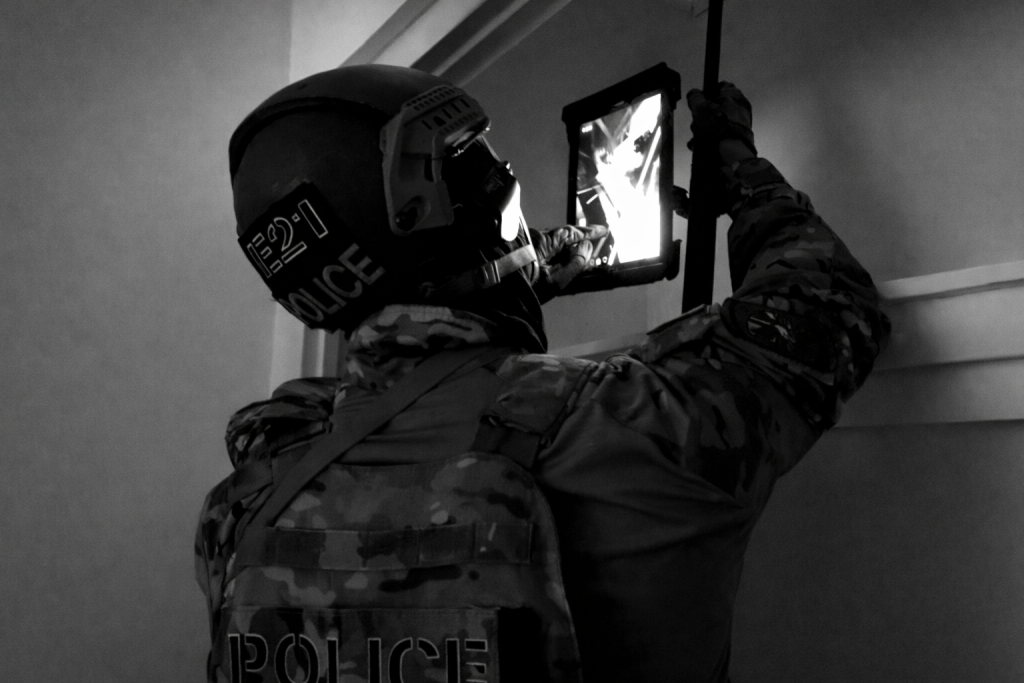
Focus on controlled, information-based entry
Tactical units often focus heavily on information gathering and risk mitigation. A 360° camera enables teams to:
Night vision capabilities
Operations often take place:
Night vision—especially with infrared or low-light color—would be crucial for:
Wireless multi-user capability
Limited use of “dynamic entry”
Since “no-knock” or forced entry is less common, police often try to surround a building and negotiate rather than storm it. A 360° camera can:
The FL360 IR-C camera fits perfectly with the priorities of European law enforcement agencies: safety, information, and accountability. It is a high-quality tool for search and breach phases, containment, and minimizing violence wherever possible.
FirstLook360 is a specialized search device for tactical and military units and may only be used by trained personnel. Transferring it to untrained or uninstructed persons is expressly not recommended, as improper use can endanger human life.
FirstLook360 and training are inseparable. When purchasing such a search camera, user training is mandatory if you do not have specialized personnel. Each customer is responsible for ensuring that the person operating the device has completed or will complete the appropriate training. They are also requested not to hand over the devices to other, non-specialized persons without training.
The terms “infrared camera” and “thermal imaging camera” are often used interchangeably, but they refer to two different technologies with different purposes, image outputs, and applications. Both operate in the infrared spectrum, which lies just outside the range of visible light, but they detect and visualize infrared energy in different ways.
Infrared cameras, often referred to as near-infrared cameras, operate in the short-wave infrared range (approx. 0.75 to 1.5 micrometers). They require an external infrared light source, such as IR LEDs, to illuminate a dark area. The camera captures the reflected infrared light and produces a black-and-white image that shows shapes and contrasts in environments with little or no light.
Typical visual output:
A person appears as a gray or white figure against a dark background; you can see facial features or clothing, but not temperature differences.
Thermal imaging cameras, also known as thermal cameras, detect long-wave infrared radiation (typically 8 to 14 micrometers) that is naturally emitted by all objects according to their temperature. These cameras operate passively and do not require a light source. They visualize heat differences using color gradients (often referred to as “false colors”) and can be used in complete darkness, through smoke, fog, or dust.
Typical visual output:
A person is displayed in warm colors such as red, yellow, or orange, while the cooler surroundings appear in shades of blue or purple. Temperature differences remain visible even through smoke or complete darkness.
WE SUPPLY DEFENSE TECHNOLOGY
At Vogt-CTE, we offer our European partners in the security and defense sector access to unique technological innovations. Our solutions are designed to make tactical operations more efficient, safer, and more effective—even under extreme conditions. The systems we represent are highly specialized, field-tested to military standards, and provide a decisive tactical advantage where it counts. We don’t just supply equipment, we deliver operational progress. Together with our partners, we ensure that these innovations end up exactly where they are needed: in the hands of those who are on the front line defending our security and who must be able to rely unconditionally on their technology.