Application 1: Support for urban warfare operations (city and area combat)
Deployment scenario: In urban combat, shelling, explosions, fires, and dust clouds quickly create complex visibility and breathing conditions. Troops must operate in difficult air conditions while simultaneously securing, searching, and holding areas.
Use of the BlowHard Quickee
The Quickee is positioned on streets, in courtyards, or near narrow passages and ensures:
- Targeted removal of smoke and dust
- Creation of clear lines of sight
- Improvement of air quality in operational areas
In this way, the Quickee supports the freedom of movement of troops and facilitates the use of optical systems (e.g., night vision, thermal imaging) and communication in urban environments.
Tactical benefits
- Increased visibility during room searches
- Reduced exposure of personnel to dust and combustion residues
- Improved operating conditions for legitimate sensor and sighting technology
Application 2: Improving board-to-ground operations at ports
Emission scenario: Military boarding operations at port facilities or ships are often confronted with confined spaces, low decks, and complex interiors with little ventilation. Smoke, gas, or contaminated air can endanger crews and delay entry.
Use of the BlowHard Quickee
The Quickee is placed at entry points, cargo holds, or bridges and directs a strong, focused airflow along the access route.
Tactical benefits
- Cleaning the air before entry
- Supporting the advance guard by reducing gas and smoke concentrations
- Improved orientation in confined spaces
- Reduction of delays during boarding
Application 3: Air pressure support for securing evacuation and casualty flows
Deployment scenario: Combat damage, explosions, or attacks create a mixture of smoke, dust, and toxic gases that can block or impede evacuation routes. The rapid rescue of injured civilians or comrades depends on passable, breathable areas.
Use of the BlowHard Quickee
The Quickee is installed along escape corridors, stairwells, or access points to create a continuous airflow that supports safe evacuation.
Tactical benefits
- Creation of safe escape routes
- Reduction in injury rates through improved air conditions
- Time savings in critical rescue phases
Application 4: Support for tactical reconnaissance and sensor integration
Deployment scenario: In modern operations, drones, sensor platforms, and optical systems help to create a picture of the situation and identify risks at an early stage. These systems are impaired by visual obstructions caused by dust, smoke, or environmental influences.
Use of the BlowHard Quickee
Directed airflow can stabilize lines of sight and remove contaminated air layers. This improves the data quality and reliability of technical reconnaissance systems.
Tactical benefits
- Faster identification of hazards
- Fewer measurement errors due to more stable visibility conditions
- Reliable sensor integration in real time
Application 5: Field camp and mobile base support
Deployment scenario: Temporary bases, field camps, and mobile support stations often lack infrastructure and air conditioning. Vehicle exhaust, dust, and unfavorable air currents can impair the performance of personnel and technology.
Use of the BlowHard Quickee
The Quickee can be used in tents, sanitary areas, equipment containers, or medical facilities to:
- Replace stagnant air
- Keep exhaust fumes away
- Improve the microclimate
- Tactical benefits
- Higher performance of personnel
- Protection of sensitive equipment
- Fewer absences due to illness
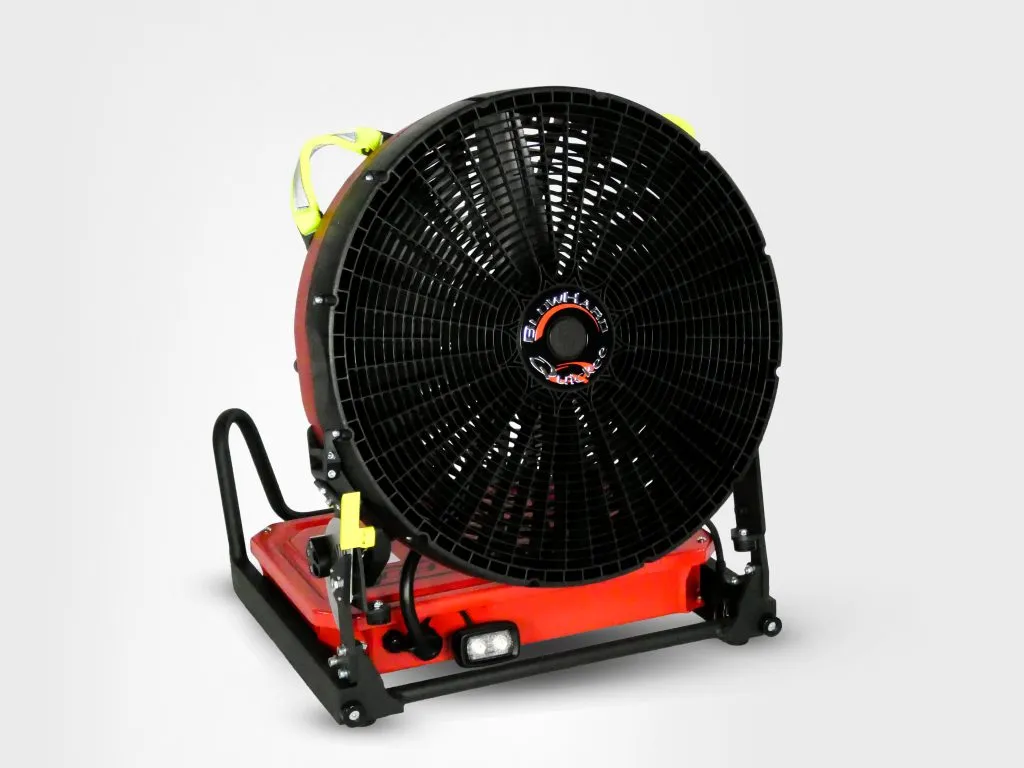
The Quickee combines powerful air volume with a robust, weatherproof design. It can be quickly positioned, aligned, and started at any tactical location—even under adverse conditions. The ability to switch between battery and mains operation guarantees both self-sufficient short-term operation and long-lasting performance. Its compact design allows a single operator to safely transport, position, and operate the device.
Safety and operational responsibility
The Quickee is used exclusively by qualified, tactically trained personnel. Situational risk assessment, knowledge of airflow dynamics, and a keen awareness of the operational environment and risks are prerequisites for safe and successful use. Particular caution is required when operating in contaminated, confined, or potentially explosive areas.
The BlowHard Quickee is a versatile, tactical air management system for military units that provides direct safety, speed, and flexibility in a variety of operational scenarios. Whether in urban combat, shipboard operations, evacuation corridors, sensor support, or field camp management, its ability to precisely control airflow offers real operational value.